








First-in-class small molecule alternative to FGF2 for stem cell culture
★ Why replace FGF2? ★ Which TCB should I use? ★ Data ★ Comparison ★ Cost savings ★ Transition guide
Pluripotent stem cells, organoids, and neural precursor cells rely on consistent FGF2 signalling to prevent unwanted differentiation. But recombinant FGF2 is notoriously unstable at 37°C - driving daily feeding (including weekends) and “feast and famine” fluctuations.
TCB-32 and its high-potency analogues, TCB-541 and TCB-621, are novel small molecule FGF2 mimetics. Unlike recombinant proteins, the TCB series remains stable in cell culture media for over 13 days, helping you eliminate daily supplementation, reduce costs, and maintain steadier signalling.
Why scientists are switching from FGF2 to TCB mimetics
- Weekend-free workflows: Stable signalling for up to two weeks without daily supplementation.
- Lower total cost: Reduce FGF2 supplementation spend dramatically versus recombinant proteins.
- More consistent performance: Defined chemical purity reduces lot-to-lot variability.
- Lower contamination risk: Fewer media changes means fewer opportunities for contamination.
- Automation-ready: Better suited for scaled, high-throughput and long-term protocols.
Cost Comparison Calculator
Save over 95% with TCB.
Published data: stability and sustained signalling vs FGF2
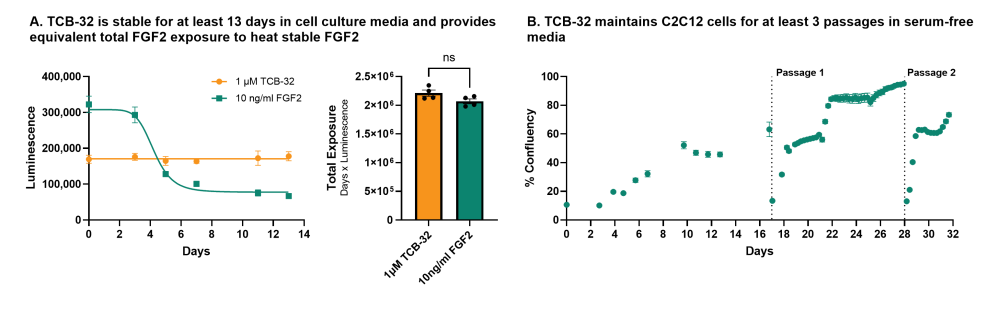
A. Effect of pre-incubation of TCB-32 and FGF2 at 37°C upon growth of NIH 3t3 cells in a luminescent proliferation assay. B. Effect of TCB-32 supplementation upon C2C12 cell growth across three passages measured using a microscopic calculation of confluency. Data source: Feofanov et al., 2025. Biochem Biophys Rep. 2025.
FGF2 vs TCB Series: a Comparative Overview
For many researchers, TCB mimetics offer a practical replacement for FGF2 in stem cell culture, delivering stable signalling without the instability, cost, and frequent supplementation required for recombinant growth factors.
| Feature | Standard FGF2 | FGF2 (Heat Stable) | TCB-32 & Analogs |
|---|---|---|---|
| Type | Recombinant protein | Engineered recombinant protein | High-purity small molecule |
| Media Changes | Daily | Every 2-3 days | Once per 14 days |
| Weekend Lab Work | Required | Occasional | None (Weekend-Free) |
| FGFR1 Signaling Profile | Rapid peak and decay within a day | Fluctuating Decay | Steady-State Plateau |
| Cost (500ml media per week) | ~20× higher | ~8× higher | Baseline |
| Handling & Storage | Fragile | Fragile | Robust |
| Consistency | High lot to lot variability in activity and endotoxin. | High lot to lot variability in activity and endotoxin. | Defined chemical consistency (>98% purity) |
- Prices compared to RND Systems BT-FGFB and BT-FGFBHS (100µg pack size, prices obtained 27/02/2026 using list prices in UK / DE / US) using stated media change intervals and a FGF2 working concentration of 20ng/ml and TCB-32 of 2µM.
Applications of TCB-32, TCB-541 and TCB-621
- Stem cell maintenance: Maintain pluripotency in hPSCs with a convenient 14-day feeding schedule[2].
- Neural induction & differentiation: Drive consistent neural precursor expansion without signalling fluctuations[3].
- Organoid culture: Support long-term growth of complex 3D cultures with superior thermal stability[4].
- High-throughput screening: Scale up assays using defined chemical consistency and reduced labour overhead.
Which TCB Compound Should You Choose today
Start with TCB-32 for the most extensively characterised workflow, or choose TCB-621 when you need maximum potency. TCB-541 provides a balanced option for demanding applications.
Order TCB-32 Order TCB-621 Order TCB-541
Equivalent packsizes of TCB compounds to FGF2 to make the same media volume
| FGF2 Pack Size | TCB-32 | TCB-541 | TCB-621 |
|---|---|---|---|
| 20µg | 2mg | 1mg | 500µg |
| 50µg | - | 2mg | 1mg |
| 100µg | 10mg | - | 2mg |
| 250µg | 25mg | 10mg | - |
| 500µg | 50mg | - | 10mg |
| 1000µg | 100mg | 50mg | 25mg |
Calculated assuming a working concentration of 20ng/ml FGF2, 2µM TCB-32, 1µM TCB-541 and 500nM TCB-621.

Ready to reclaim your weekends?
Download our FGF2-to-TCB Transition Guide with reconstitution protocols, step-by-step instructions for 14-day feeding schedules, and validated confluency benchmarks for hPSCs and organoids.
Download Transition Guide (PDF)Includes equivalency tables for TCB-32, TCB-541, and TCB-621.
References
- Feofanov et al., 2025. Discovery and optimization of a guanylhydrazone-based small molecule to replace bFGF for cell culture applications, Biochem Biophys Rep. 2025 Jul 21;43:102167. PMID: 40734998
- Lotz et al., 2013. Sustained levels of FGF2 maintain undifferentiated stem cell cultures with biweekly feeding. PLoS One. 2013;8(2):e56289. PMID: 23437109
- Rosenblatt-Velin et al., 2005. FGF-2 controls the differentiation of resident cardiac precursors into functional cardiomyocytes. J Clin Invest. 2005 Jul;115(7):1724-33. PMID: 15951838
- Qu et al., 2021. Establishment of intestinal organoid cultures modeling injury-associated epithelial regeneration. Cell Res. 2021 Mar;31(3):259-271. PMID: 33420425